By Ahmed | Scale Up Media Group — Paid Media Strategist
Is Google Ads Worth It in 2026? The Truth About Bots, Click Fraud, and Real ROI
Spend ten minutes in any small business forum and you’ll see the same complaint: “I ran Google Ads, got a bunch of clicks, and not a single real lead. It’s all bots.”
It’s a fair frustration. Ad costs keep climbing, some of your clicks really are fake, and Google isn’t exactly loud about either of those facts. But the honest answer to “is Google Ads worth it” isn’t yes or no. It’s this: Google Ads is still the highest-intent traffic you can buy, and most accounts that “don’t work” are leaking money in ways that are completely fixable.
Let’s break down what’s actually happening with bot clicks, what the data says, and how to decide whether Google Ads makes sense for your business in 2026.
The short answer
Yes, Google Ads is still worth it for most local and service businesses, but only if you protect your budget from invalid traffic and track leads properly. Around 11% of Google Ads clicks are invalid on average, which means roughly 89% are real people searching for what you sell. The businesses that lose money aren’t victims of bots. They’re usually running loose targeting, no negative keywords, and no conversion tracking.
If you want a professional eye on your account, our Google Ads management team audits campaigns for wasted spend before we ever talk about scaling budget.
Are Google Ads clicks really bots?
Some are. Nobody serious in this industry will tell you otherwise.
Here’s what the current data shows:
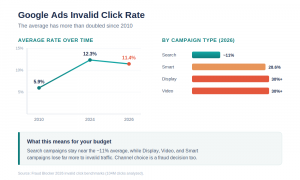
- The average invalid click rate across Google Ads sits around 11.4%, and it has been climbing as AI-driven bots get more sophisticated
- Display, Video, and Smart campaigns are hit hardest, with invalid rates reaching 28 to 30%+, while Search campaigns are much cleaner
- Industry-wide, estimates put fraudulent or invalid clicks at 14 to 20% of all ad clicks, with high-CPC local niches like legal and home services sometimes seeing worse
So the “it’s all bots” claim is wrong, but “some of it is bots” is absolutely right. The difference matters. If 11% of your clicks are invalid and you’re doing nothing about it, you’re paying a hidden 11% tax. Annoying, but survivable. If you’re running Display or Smart campaigns with no exclusions, that tax can be a quarter of your budget or more.
What counts as an invalid click?
Google defines invalid clicks as clicks that don’t come from genuine user interest. That bucket includes:
- Bots and automated scripts, including the newer wave of AI crawlers and scrapers
- Competitor clicks, where a rival taps your ad to burn your budget (common in local services with expensive keywords)
- Click farms, paid humans clicking ads at scale
- Accidental clicks, fat-finger taps on mobile
- Publisher fraud, site owners clicking ads on their own pages to earn revenue
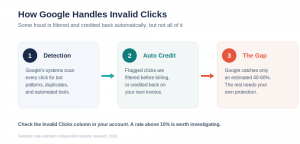
Google filters a lot of this automatically and credits you back for the invalid clicks it catches. You can see this in the “Invalid clicks” column in your account. The problem is what slips past the filter, because sophisticated bots now mimic real browsing behavior well enough to fool basic detection.
Why “Google Ads doesn’t work” is usually a different problem
Here’s what we see when we audit accounts for businesses across Brooklyn and Queens: click fraud is almost never the main reason an account is bleeding. These are:
1. No negative keywords. You’re a private pay home care agency and your ads show for “free home care” and “home care jobs.” Those clicks are real humans. They’re just the wrong humans, and they cost the same as the right ones.
2. Location targeting set to “Presence or interest.” Google’s default setting shows your ads to people interested in your area, not just people in it. A plumber in Hicksville ends up paying for clicks from other states. Switching to presence-only targeting is a two-minute fix that saves real money.
3. No conversion tracking. If you’re not tracking calls and form fills, every click looks like a failure. Half the “Google Ads is a scam” posts online come from advertisers who genuinely got leads and never measured them.
4. Smart campaigns and default settings. Google’s simplified campaign types trade control for convenience, and the data shows Smart campaigns carry some of the highest invalid traffic rates on the platform. Search campaigns with exact and phrase match keywords are far more protected.
5. Weak landing pages. Real click, real person, page loads slow or asks for too much. They bounce. That’s not fraud, that’s conversion rate.
Fix these five things and most “dead” accounts come back to life without spending a dollar more.
How to protect your budget from bots and junk clicks
Practical steps, in order of impact:
- Stick to Search campaigns if you’re a local business. Skip Display and Smart campaigns unless you have a specific reason and tight exclusions.
- Set location targeting to “Presence” so you only pay for people physically in your service area.
- Build a negative keyword list and add to it weekly from the search terms report. Free, jobs, DIY, salary, and competitor-irrelevant terms are the usual suspects.
- Watch your invalid clicks column. Google reports it under Columns > Performance. If your rate runs above 10%, dig in.
- Exclude suspicious IPs. You can block up to 500 IP addresses per campaign in settings.
- Consider third-party fraud protection once you’re spending $5K+ per month or you’re in a high-fraud niche. Below that, the tools often cost more than they save.
- Track everything. Call tracking, form tracking, and offline conversion imports turn Google Ads from a slot machine into a math problem.
So, Is Google Ads Worth It for Small Businesses?
Google Ads works best when someone is actively searching for what you offer and the value of a customer justifies the click cost. That’s why it stays profitable for:
- Home care and home health agencies, where one client relationship is worth thousands
- Home services like roofing, HVAC, and plumbing
- Medical, dental, and legal practices
- Local B2B services
Average CPCs run $1 to $5 in most industries, and typical small business budgets land between $1,000 and $2,500 per month. If your average customer is worth $500+, the math usually works even after accounting for invalid traffic.
Where it gets harder: very low ticket products, brand new inventions nobody searches for yet, and businesses unwilling to fix their landing page. In those cases, we’ll tell you straight that your money is better spent elsewhere. Sometimes that’s SEO, sometimes it’s Meta, sometimes it’s CTV.
For businesses on Long Island, including Hicksville and Bethpage, competition is often lighter than the five boroughs, which means cheaper clicks and faster payback. It’s one of the better-kept secrets in Nassau County marketing.
The bottom line
Google Ads in 2026 is not a scam and it’s not a magic button. It’s an auction where roughly nine out of ten clicks are real people, costs keep rising, and the advertisers who win are the ones who run tight targeting, block the junk, and measure their leads.
If your ads “aren’t working,” the odds are overwhelming that the problem is fixable, and the fix is usually in settings, keywords, and tracking rather than some unstoppable bot army.
Want to know exactly where your budget is going? We’ll run a free audit of your account, show you your real invalid click rate, and tell you honestly whether Google Ads is worth it for your business. Get in touch with Scale Up Media Group.
FAQ
What percentage of Google Ads clicks are bots? The average invalid click rate in Google Ads is around 11%, though Display, Video, and Smart campaigns can see rates of 28 to 30% or higher. Search campaigns with tight targeting are the most protected.
Does Google refund invalid clicks? Yes, Google automatically filters and credits invalid clicks it detects. You can view these in the Invalid Clicks column. For suspected fraud Google missed, you can file a claim through the Invalid Clicks Contact Form, though approvals require solid documentation.
Is Google Ads worth it for a small local business? For most service businesses where a customer is worth $500 or more, yes. Typical budgets start around $1,000 to $2,500 per month. The key is presence-only location targeting, negative keywords, and conversion tracking from day one.
How do I know if my ads are getting fake clicks? Warning signs include sudden CTR spikes with zero conversions, invalid click rates above 10%, traffic from locations you don’t serve, session durations under five seconds, and repeat clicks from the same IPs.
Should I use click fraud protection software? It makes sense once you’re spending $5,000+ per month or you’re in a high-fraud industry like legal or home services. Under that, fixing targeting and exclusions usually delivers more savings.