By Ahmed Sohail | Scale Up Media Group
A digital marketing budget for small business owners should answer a fairly simple question: what can you afford to spend to bring in a customer and still make money?
That is a better starting point than picking a monthly amount because another business spends it. A Bay Ridge contractor booking larger projects and a Williamsburg salon selling appointments have different margins, capacity, and reasons people call. Their marketing plans should reflect that.
For a Brooklyn business, start by pricing one focused campaign, the work needed to manage it, and the website and tracking it needs. Then compare the full cost with the customers you can realistically serve. There is no single monthly figure that makes sense for every business.
This guide shows how to put those numbers together, what an agency quote should include, and when to hold off on increasing your spend.
Planning a Digital Marketing Budget for Small Business Growth
Before asking for quotes, write down the service you want to sell, where you want to sell it, and how much additional work you can handle.
“More leads” leaves too much open to interpretation. “More requests for bathroom renovation estimates in the parts of Brooklyn we serve” gives you something useful to plan around.
Include these details in your brief:
- Your priority service or product.
- The neighborhoods or service areas you can cover.
- What makes an inquiry a good fit.
- How many new customers you can handle.
- The amount you can commit without depending on immediate returns.
If you are unsure which service to promote first, choose one with clear demand, enough margin to support acquisition costs, and capacity to deliver. You can broaden the campaign later.
Our digital marketing services for Brooklyn businesses cover paid advertising and SEO. A useful first conversation starts with your business goals and constraints, then works toward the channels that fit.
Separate Advertising Spend From the Cost of Managing It
A proposal that says “$3,000 a month for marketing” needs an explanation. Does that include money paid to Google or Meta? Who builds the landing page? Is tracking included?
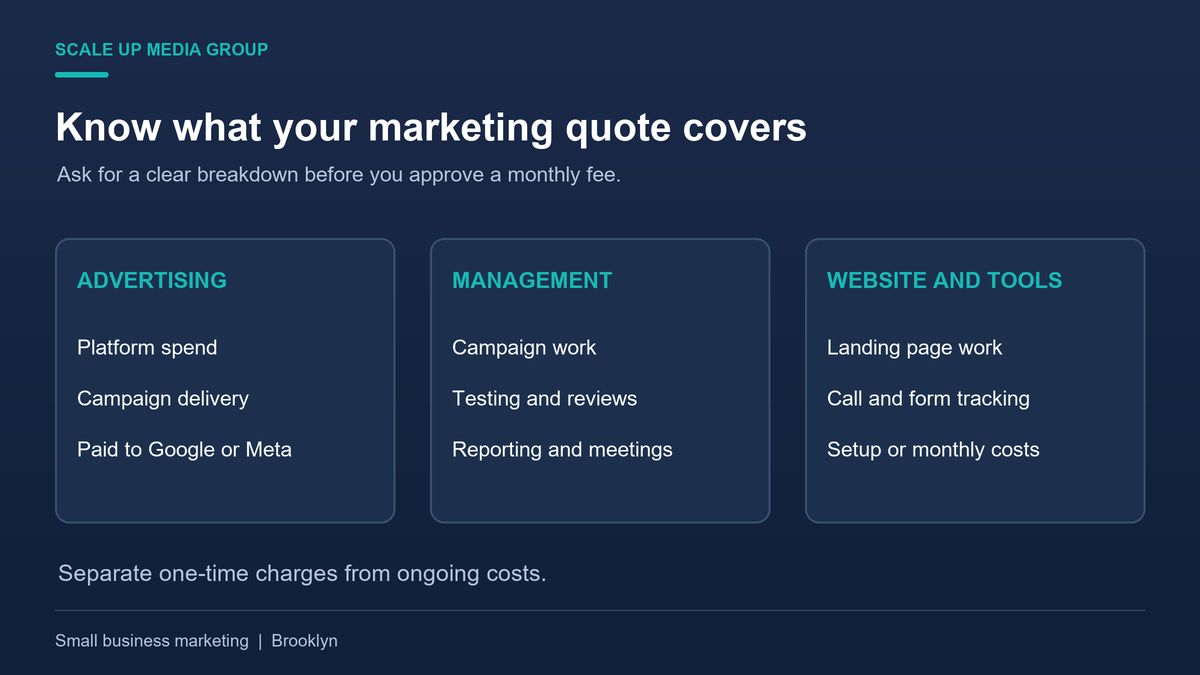
Ask for the costs to be separated into three parts.
Advertising spend
This is the money paid to the advertising platform to run your campaigns. It should be clearly separated from the fee for managing them. Confirm who owns the advertising account and how billing works.
Management and ongoing work
This may cover campaign setup, search-term reviews, bid and budget changes, ad testing, reporting, and meetings. For SEO, it may cover website improvements, local listing work, or content. The proposal should name the deliverables instead of simply listing “optimization.”
Website work and tools
A new landing page, call tracking, design, or website repairs may have separate charges. Ask which costs are one-time and which repeat each month. Check whether unused services or software can be cancelled.
Tap or click the graphic to open the full-size image.
A Sample Monthly Budget and What It Actually Covers
The following is an illustrative planning example, not a Brooklyn market average, a Scale Up Media Group quote, or a recommended minimum.
| Budget item | Example monthly amount | Purpose |
|---|---|---|
| Advertising spend | $3,000 | Pay the platform to run one focused campaign |
| Campaign management | $900 | Manage the campaign and review results |
| Tracking and page support | $300 | Maintain measurement and make agreed page updates |
| Total | $4,200 | Combined monthly cost in this example |
A new website or substantial landing page build would need a separate allowance if it was outside that scope. Your actual proposal could look quite different.
For paid search, request a forecast for your services and target locations. Google Keyword Planner can estimate clicks and other campaign outcomes at different spending levels. Those estimates help you test whether a plan is plausible; they are not a promise of results.
Also check how platform budgets work. For most Google Ads campaigns, a monthly spending limit is based on the average daily budget multiplied by 30.4, and daily spend can vary. See Google’s budget overview before assuming that a daily setting is a fixed daily charge.
Should You Start With Google Ads or Local SEO?
The right choice depends on how customers find you and what is already working. You do not need every channel on the first proposal.
Consider Google Ads when people already search for your service
A person searching for a specific repair or an appointment may be ready to contact a business. Search advertising can put your offer in front of that person, provided the budget, targeting, and destination page make sense.
Start with the services and locations you can support. A contractor covering Bay Ridge and nearby areas should question a plan that spends across all of New York City without a clear reason.
Consider local SEO when local discovery matters
If customers use Google Maps or compare nearby providers, your Business Profile and website deserve attention. Accurate services, hours, contact details, and useful local information give people a clearer picture of your business.
Google says local results depend mainly on relevance, distance, and prominence. You cannot pay Google for a better local ranking. Its local ranking guidance is a useful reference when reviewing promises in an SEO proposal.
Choose social advertising for a clear reason
Some offers need a visual introduction before people search for them. Social advertising may be worth testing in that situation, but it still needs suitable creative, a clear offer, and a way to judge the quality of inquiries.
If the budget is tight, funding one channel properly is often a more useful test than dividing it among several campaigns that each receive very little attention or traffic.
Work Backward From a Customer You Can Afford to Acquire
Revenue alone does not tell you what a new customer is worth. You also need to know the direct cost of delivering the work, the overhead the business must cover, and how long it takes to get paid.
A repeat customer may be worth more than their first purchase, but base that assumption on your own records. Do not justify a campaign using repeat sales you hope will happen.
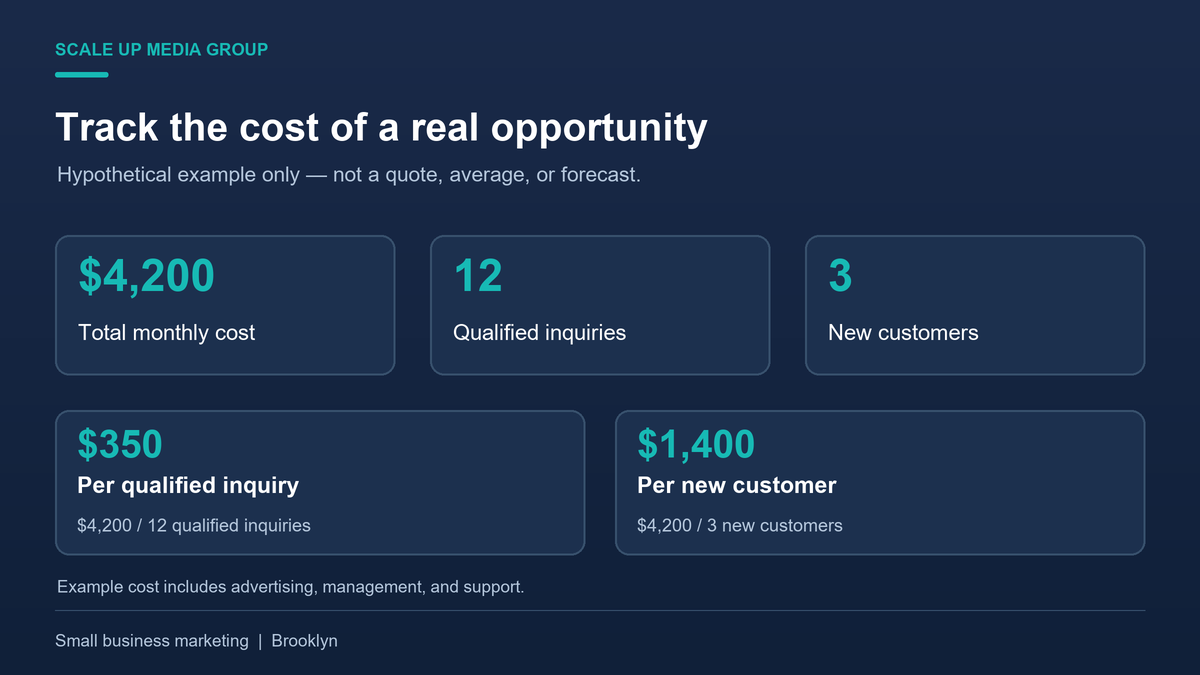
Once you have a workable acquisition-cost target, use it to assess your results. Suppose the illustrative $4,200 campaign produces 30 inquiries, 12 of which fit your services, and three become customers:
- Cost per inquiry: $4,200 divided by 30 = $140.
- Cost per qualified inquiry: $4,200 divided by 12 = $350.
- Cost per new customer: $4,200 divided by three = $1,400.
These are hypothetical outcomes, not forecasts. Whether $1,400 per customer is acceptable depends on the business. It could be unworkable for a small one-time purchase and worth evaluating for a larger job with sufficient margin.
Be consistent about the costs you count. A report showing only advertising spend will produce a different acquisition cost from one that includes management and tools.
Tap or click the graphic to open the full-size image.
Check Your Website and Follow-Up Before Spending More
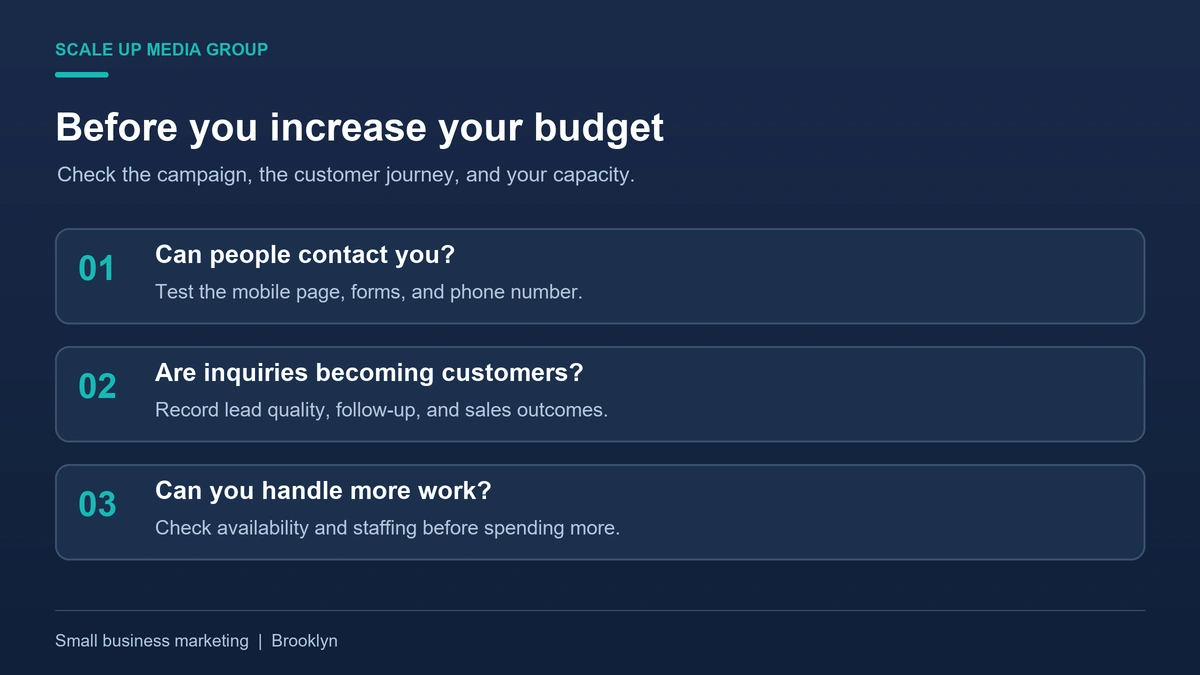
If people click but do not contact you, increasing the budget may just send more people through the same weak experience.
Open your landing page on a phone. Can someone quickly see what you do, where you work, and how to contact you? Does the form send successfully? Does someone answer the advertised phone number?
If inquiries arrive but do not turn into sales, ask why. Wrong service? Wrong location? Price mismatch? Slow callbacks? Each points to a different fix.
Keep a simple record of inquiry source, service requested, qualification, next step, and outcome. A spreadsheet can be enough to start. The important part is that somebody updates it and shares the findings with the person managing your marketing.
What to Ask Before You Approve a Marketing Proposal
Compare proposals on scope and accountability as well as price. A lower fee can be good value, but only if it includes the work you need.
- What is included in the fee, and what costs extra?
- Which campaign or service will we start with, and why?
- Who owns the advertising accounts, website assets, and data?
- How will calls, forms, qualified inquiries, and sales be measured?
- Who handles landing page changes and technical problems?
- How often will results be reviewed with us?
- What would lead you to change the plan, reduce spending, or stop?
- What are the contract term and cancellation conditions?
Ask for the answers in writing. It is much easier to resolve differences over reporting, access, and deliverables before the campaign starts.
When to Increase Your Digital Marketing Budget
Increase spending when the existing activity gives you a reason to do so. You should be able to identify suitable inquiries, see customers coming from them, and understand whether the acquisition cost works.
You also need capacity. More appointment requests do little for a business that cannot return calls or offer available dates.
Review performance over a period that suits your sales cycle. A same-day repair business and a company selling larger renovation projects will not get equally useful answers from the same short reporting window.
When the evidence supports an increase, make a measured change and watch lead quality and cost. Higher spend does not necessarily preserve the same results at a larger scale.
Tap or click the graphic to open the full-size image.
Frequently Asked Questions
How much should a small Brooklyn business spend on digital marketing?
Build the budget around your priority service, current local advertising forecasts, delivery margin, and capacity. Include advertising, management, and supporting website costs. The $4,200 example above explains the components; it is not a minimum or a market average.
Can I start with a smaller budget?
Yes, but narrow the scope. You could improve your website and Business Profile first, or price a focused campaign for one service area. If a paid campaign cannot attract enough relevant traffic within your budget, discuss another approach instead of expecting the same results for less spend.
Does an agency fee include Google or Facebook advertising spend?
It depends on the proposal. Ask for platform spend, management, tools, and setup charges to be listed separately. Confirm whether you pay the advertising platform directly and retain access to the account.
Should I spend a fixed percentage of revenue?
A revenue percentage can help set an overall limit, but it does not tell you what a useful campaign will cost. Check local demand, acquisition costs, cash flow, and capacity before choosing the final amount.
How long should I test a campaign before deciding whether it works?
Agree on a review period that reflects your budget, traffic, and sales cycle. Check tracking and inquiry quality early. Assess customer acquisition after enough opportunities have had time to move through your sales process.
Can paying for ads improve my organic rankings?
No. Buying advertising does not improve your organic search ranking. Google explains the separation in its guide to paid and organic search results.
What should I bring to a marketing strategy call?
Bring your website address, priority services, service area, comfortable spending range, and any existing campaign results. If possible, include recent inquiry and sales numbers. Those details make budget recommendations more specific.
Get a Marketing Budget That Fits Your Brooklyn Business
You should leave a budget conversation knowing what you are paying for, what will be measured, and what the first review will cover.
Scale Up Media Group works with Brooklyn businesses on paid advertising and SEO. Visit our Brooklyn digital marketing page to explore the services and book a free strategy call.
Tell us which service you want to grow, where your customers are, and what you can comfortably invest. We can discuss a focused starting plan around those details.
About the Author
Ahmed Sohail is the founder of Scale Up Media Group, a marketing agency serving businesses in Brooklyn, Long Island, and the greater New York area. His work focuses on paid advertising and lead generation.