By Ahmed Sohail | Scale Up Media Group
Google Ads for home care agencies can bring in inquiries, but more inquiries do not always mean more clients. A home care agency can spend money on advertising and still receive calls from job applicants, families outside its service area, or people seeking services it does not provide.
Google Ads for home care agencies works best when the campaign connects the right search with the right service, landing page, and intake process. For agencies serving New York, that means being specific about geography, care options, and who the campaign is intended to reach.
This guide explains how to build a home care paid advertising strategy around qualified client inquiries, rather than treating every click or phone call as a success.
What Is a Qualified Home Care Lead?
A qualified lead is an inquiry that fits your agency’s services and can move toward a meaningful next step. Before launching a campaign, your marketing and intake teams should agree on what that means.
Useful qualification criteria include:
- The person needs care in an area your agency serves.
- The requested service matches what your agency is authorized and staffed to provide.
- The payment arrangement fits the options your agency accepts.
- The family has a realistic timeline for starting care.
- Your team can contact the person and arrange an appropriate next conversation.
A caregiver seeking employment may be valuable to your recruitment team, but that inquiry should not count as a new client lead. Keeping those outcomes separate makes your reporting more useful.
For help connecting advertising with intake and staffing goals, explore Scale Up Media Group’s home health care marketing services in New York.
1. How to Choose Keywords for Google Ads for Home Care Agencies
Start with the services your agency can actually deliver. Non-medical home care and skilled home health services should not be presented as interchangeable simply because their search terms look similar.
Possible client-facing keyword themes include:
| Service or intent | Example search | What the landing page should explain |
|---|---|---|
| Local home care | home care agency Brooklyn | Services, coverage, and how to inquire |
| Private-pay care | private pay home care Queens | Payment approach and consultation process |
| Companion care | companion care Nassau County | Available support and service limitations |
| Respite care | respite care Long Island | Availability, scheduling, and next steps |
These are starting examples, not verified search-volume estimates. Validate demand and costs in your advertising account before committing a budget. Advertise only services and payment options your agency offers.
Use phrase and exact match as a controlled starting point when appropriate, then review the searches that trigger your ads. Exact match can include searches with the same meaning or intent; it does not mean only the identical typed phrase. Google’s keyword matching guide explains how the options differ.
One distinction matters: families may search for “home care agency Brooklyn.” An agency owner looking for marketing support may search for “home care Google Ads agency.” Your client acquisition campaign should focus on the first kind of search.
2. Separate Client Acquisition From Caregiver Recruitment
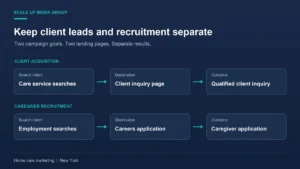
Home care lead generation can become difficult to evaluate when client inquiries and job applications share the same campaign goals.
Build separate campaigns, landing pages, forms, and conversion actions for recruitment. Give each campaign a budget and a clear definition of success.
For client campaigns, review employment-related searches and consider negatives such as “caregiver jobs,” “HHA jobs,” “PCA jobs,” “salary,” and “certification classes,” where they are irrelevant. Apply exclusions at the campaign level when account-wide exclusions would interfere with your recruitment advertising.
Negative keywords help exclude unwanted searches, but their match rules differ from positive keywords. Review related wording and avoid blocking useful service inquiries by mistake. See Google’s explanation of negative keywords.
Also make the destination clear: use a client-focused headline and call to action, with a separate careers link for job seekers. Exclusions alone cannot solve confusion on a landing page.
3. Target the New York Areas You Can Serve
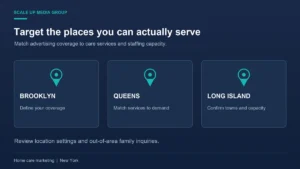
A campaign covering all of New York State is a poor fit for an agency that can only staff cases in selected parts of Queens or Nassau County. Match your advertising footprint to your actual capacity.
For example, an agency serving Brooklyn and Nassau County could organize campaigns around those areas when budget and demand justify separate reporting. Within each campaign, group related services so the ad and landing page answer the same need.
Choose location settings deliberately. Google’s location targeting guidance distinguishes people present in an area from people who have shown interest in it. Presence targeting can help when you want local searchers. However, an adult child living elsewhere may be arranging care for a parent in New York, so evaluate whether a separate, carefully controlled approach is appropriate for those inquiries.
Do not split a limited budget into more campaigns than it can support. Start with your strongest service areas and expand when lead quality and staffing capacity justify it.
4. Send Each Ad to a Relevant Landing Page
A family clicking an ad for companion care in Queens should immediately find information about companion care and Queens coverage. A general homepage may leave too many questions unanswered.
A useful home care landing page includes:
- A clear description of the service and locations covered.
- Accurate information about payment options and availability.
- A visible phone number and a short inquiry form.
- Genuine reviews or testimonials you have permission to use.
- A simple explanation of what happens after the inquiry.
- A separate route for employment applications.
Keep the first form focused on contact details and basic service fit. Avoid asking families to submit detailed medical histories through a general advertising inquiry form.
Use direct ad copy such as “Home Care in Queens” and “Speak With Our Intake Team” when those statements accurately reflect your service. Avoid promises about immediate staffing, coverage, or outcomes that your team cannot substantiate.
5. Make Intake Part of the Advertising Plan
Before increasing ad spend, test your own intake experience. Call the advertised number, submit the form, and confirm that inquiries reach the right person.
Set an internal response target and a follow-up process. If you encourage people to call, align that invitation with staffed hours or provide clear expectations for callbacks.
Your intake team should record the requested service, care location, payment fit, next step, and reason an inquiry was unsuitable. These details help distinguish an advertising problem from an availability or follow-up problem.
6. Measure Qualified Leads and Client Starts
Clicks show engagement, but they do not tell you whether a campaign is producing suitable opportunities. Track calls and form submissions, then review what happened after contact.
Google supports several forms of phone call conversion tracking. A call-duration threshold can help screen brief calls, but a long conversation is not proof of a qualified client inquiry.
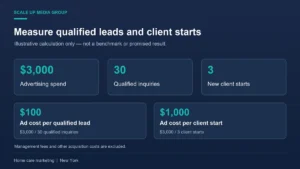
Useful business measures include cost per qualified lead, consultation bookings, new client starts, and the share of inquiries that become clients.
Illustrative example: If a campaign spends $3,000 and produces 30 qualified inquiries, its advertising cost per qualified lead is $100. If three become clients, its advertising cost per client start is $1,000. These figures demonstrate the calculation; they are not New York benchmarks or promised results. Management fees and other acquisition costs would need to be added for a fuller cost calculation.
Keep detailed care information in the appropriate intake system. Do not send diagnoses or sensitive care details through advertising tags, event names, or page URLs.
7. Plan Your Budget Around Capacity and Economics
There is no single budget that suits every home care agency. Your test budget should reflect local click costs, the services being promoted, expected inquiry quality, and the number of new cases your team can staff.
Separate media spend from management, landing page, and tracking costs. Set a review point before launching, then assess whether the campaign has generated enough useful information to guide changes.
Our related article on Google Ads costs for home care agencies in New York discusses budgeting. Use estimates as planning inputs and confirm current figures for your own service area.
Increase spend when qualified inquiries, client starts, and service capacity support the decision. A low cost per click alone is not a reason to expand.
8. Review Health Advertising and Audience Restrictions
Home care advertising requires care with audience selection and health-related messaging. Google’s personalized advertising restrictions limit certain targeting methods for sensitive categories, including health.
Do not assume that remarketing lists built from health-related page visits or customer lists containing patient information are appropriate for an advertising campaign. Review the services, landing pages, and targeting methods together before using audience features.
Keep recruitment campaigns under separate review, because employment advertising has its own targeting restrictions. Write respectful copy that describes available services without suggesting you know a viewer’s medical condition.
Google Ads for Home Care Agencies FAQs
Can Google Ads work for a small home care agency?
It can be worth testing when the agency has a defined service area, capacity to accept clients, a workable budget, and reliable intake. Start with a focused offer and measure qualified inquiries before expanding.
How can we reduce caregiver applications in client campaigns?
Separate recruitment campaigns and conversion goals, review employment-related search terms, and make the client landing page’s purpose clear. Some unsuitable inquiries may still occur, so record their outcomes.
Should we advertise across all five boroughs?
Only if your agency can serve them and your budget can support the coverage. Begin with locations where you can respond to inquiries and staff new cases reliably.
Does buying Google Ads improve organic rankings?
No. Paid advertising and organic search rankings are separate. Google confirms this in its guide to measuring paid and organic search results.
How much should a New York home care agency budget for Google Ads?
Build a budget from current keyword forecasts, your service area, and the number of qualified inquiries you need. Account for media spend, management, landing pages, and tracking separately. Test the economics against your own staffing capacity and client acquisition costs rather than relying on a universal minimum.
How quickly can Google Ads generate home care leads?
Ads may begin attracting traffic once they are approved and eligible to run, but qualified inquiries and client starts are not guaranteed on a fixed schedule. Review search demand, competition, budget, landing page performance, and intake outcomes before deciding whether to expand.
Do we need a dedicated landing page for each location?
Use a dedicated location page when it provides useful, accurate information about care in that area. Avoid creating near-identical pages that only swap place names. A strong service page covering several genuine service areas can be more helpful than multiple thin pages.
What should we ask a home care Google Ads agency before hiring?
Ask how it separates client and recruitment campaigns, measures qualified inquiries, reviews search terms, and reports client starts. Clarify account ownership, management fees, media spend, landing page responsibilities, and how your intake team will share feedback.
Build a Campaign Around the Clients You Can Serve
Google Ads for home care agencies in New York needs more than a list of keywords. Service fit, local coverage, landing pages, intake, and measurement all shape whether an inquiry becomes an opportunity.
Scale Up Media Group helps New York home care agencies plan client acquisition and caregiver recruitment campaigns. Explore our New York home care marketing services and book a strategy call to discuss your service area, capacity, and campaign goals.